Arizona voters could have two competing — and probably confusing — choices to make about school vouchers in November.
A few weeks ago, pro-public school groups announced they planned to put a measure on the ballot to rein in the voucher program, which costs about $1 billion annually. They’re trying to block wealthy people from using vouchers and force schools that accept voucher money to comply with a lot of the same rules as public schools.
Now, a pro-school choice group says they’re going to put another measure on the ballot, which they pitch as adding accountability to the program without gutting it.
We read through both measures, and it’s clear that voters are going to need help distinguishing between the two.
So, today we’re going to pull them apart and see what’s in each one. That should give you a head start on understanding them a little better when your pen is hovering over your ballot in November.
Today’s guide also could come in handy long before then. The groups backing these measure need to gather about 250,000 signatures by early July, which means you might hear a knock on your door and be asked to sign your name to one measure or the other.
You’ll want to know which is which first.

Muddying the waters
If you’re wondering why it would be difficult to tell the two measures apart, just look at their titles: The “Arizona Empowerment Scholarship Account Reform and Accountability Act” and the “Protect Education Act.”
Not a lot to glean there, right?
It gets worse. Check out the first sentence of each measure’s overview filed with the state:
“Strengthens transparency, accountability, and safety in Empowerment Scholarship Account (ESA) program (commonly called “vouchers”), while protecting access for students with disabilities and other pre-2022 eligibility categories.”
“Strengthens transparency, accountability, and fiscal integrity in the Empowerment Scholarship Account (ESA) program without Infringing on parental choice.”
If you make it through the nearly identical first halves of those sentences, you might pick up on a couple key differences.
The first measure is backed by the Arizona Education Association — the biggest teachers union in the state — and the activist group Save our Schools Arizona. They both oppose vouchers and designed their ballot measure to rein in the program (we’ll call them Team Public Schools).
You’ll notice they use the word “vouchers,” which is a dead giveaway that the initiative doesn’t come from the school choice crowd.
The second measure is backed by the political action committee Fortify AZ. We don’t know much about them yet, other than their ballot measure is supported by the national school choice advocacy group, American Federation for Children.
You can see they included “parental choice” in their overview. One of the fundamental principles of the movement is that parents should have a choice in where they send their kids to school (we’ll call them Team School Choice).

For some voters, just knowing which team wrote the measure will be enough.
You don’t like vouchers? Go with Team Public Schools.
You like vouchers? Go with Team School Choice.
But other voters might want to get into the details of what each measure would do.
The nitty gritty
First up, should wealthy families be able to use vouchers?
That was a big complaint when the Legislature made the program universal in 2022 and all of a sudden most of the vouchers were being used by wealthy families whose kids were never in public school to begin with.
Team Public Schools: “Limits eligibility under 2022 expansion to families with annual Income of $150,000 or less (adjusted annually).”
Team School Choice: No income cap.
What can parents buy with voucher money?
For quite a while now, we’ve been reading about parents using voucher money to buy lingerie, diamond earrings, gas masks and a wide array of other items that don’t seem like they’re connected to education in any way.
As the public uproar grew, the Arizona Department of Education conducted an audit of expenses paid for by voucher money. The Arizona Republic turned that long list of “unallowable” purchases into a searchable database.

Arizona Treasurer Kimberly Yee, who is running for superintendent of public instruction in the GOP primary against incumbent Tom Horne this year, has been loath to put any type of restrictions on voucher spending that would offend the Freedom Caucus that’s backing her campaign.
But even she has started to soften her stance a little. She recently said she’s looking for a new vendor for the marketplace where parents spend voucher money, although she maintains that move has nothing to do with the scandals that keep making headlines.
Team Public Schools: “Further restricts use of (vouchers) … for luxury Items.” They define luxury items as furniture, appliances, home improvements, jewelry, lingerie, admission to amusement parks, and home swimming pools, among other items.
Team School Choice: “Restricts allowable ESA expenditures, explicitly prohibiting noneducational and luxury purchases (as defined).” Their definition of luxury items is almost identical to the definition used by Team Public Schools.
Their measure also “permanently disqualifies parents who knowingly misuse monies with intent to defraud and bars disqualified parents from enrolling any child in the program.”
And, in the same vein as Yee’s move, the Team School Choice measure “mandates the Department of Education to establish an ‘online marketplace payment system’ by July 1, 2027, through which all ESA purchases must be processed directly with approved vendors; eliminates reimbursements and debit cards after the date.”
What happens when parents don’t spend all their voucher money?
That might not sound like a pressing issue, but it actually involves a lot of money. Reporting from 12News showed parents “stockpiled” $440 million in unused voucher money.
Team Public Schools: “Prescribes disqualification grounds, expands grounds for recouping unspent funds, allocates recouped funds (Including to classroom site fund).”
Team School Choice: Doesn’t make changes to unused money portions of the law.
What about qualifications for teachers and schools?
Democratic lawmakers and public school advocates have long demanded private schools meet the standards for public schools if they want to receive voucher money.
On the other hand, school choice advocates don’t want the state horning in on private schools or homeschoolers.
Team Public Schools: “’Qualified tutors’ and personnel at ‘qualified schools’ and ‘qualified tutoring service providers’ need valid fingerprint clearance and are subject to State Board of Education discipline.”
Their measure also states: “Qualified schools must be accredited or administer state assessments (except for students with disabilities).”
Team School Choice: “Requires students not enrolled full-time at a qualified school to participate In an ‘approved examination’ (as defined) beginning in 2027-2028; directs ADE to maintain lists of approved examinations and curricula, including faith-based options.”
Did you catch that last part, about “faith-based options”? That’ll probably raise some hairy questions as the public debate over these ballot measures plays out.
Their measure also “Requires ‘qualified tutors,’ ‘qualified tutoring service providers,’ and qualified school personnel with unsupervised student contact to hold valid fingerprint clearance cards.”

Arizona’s future economic health depends on whether students know how to move from school into meaningful careers — and whether those opportunities are actually within reach.
When students can see those pathways clearly, Arizona can build the homegrown workforce that our growing economy needs to support high-wage, high-skill jobs. Programs that help students understand how the education they are receiving connects to real opportunities are vital to making that happen.
The Guarantee Your Future with Freeport initiative highlights how partnerships between education, industry, and communities make these career paths easier to see and easier to pursue.
By giving students and families information, resources, and exposure to high-demand careers, the program helps learners better understand what comes after high school and how to get there. Efforts like this show why aligning education and workforce systems matter. When students have the right tools and information, they can make smarter decisions about their futures — especially as factors like AI are rapidly changing the job market.
Recent coverage from 12News highlights how this partnership is helping Arizona students explore career pathways while supporting the state’s long-term workforce goals.


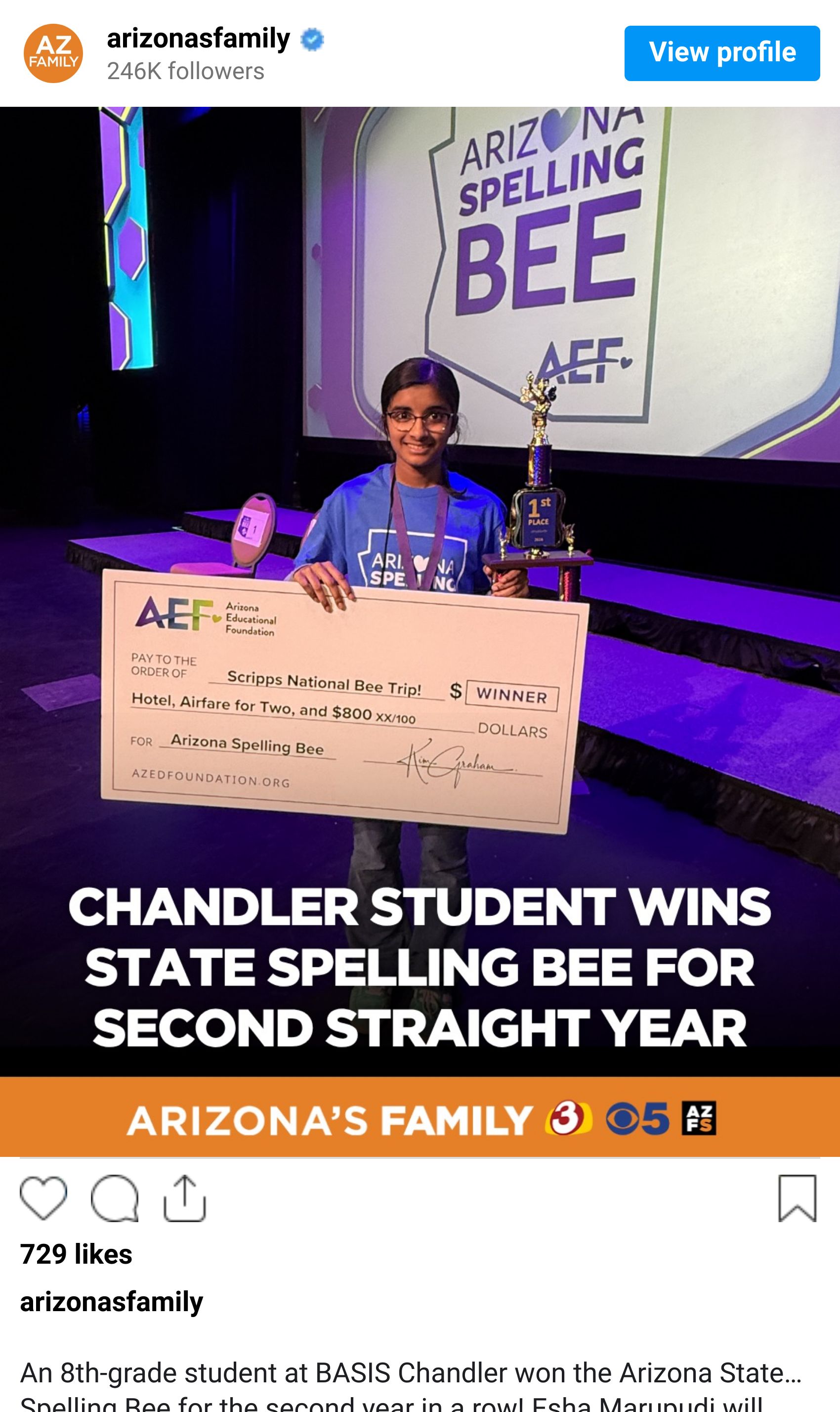
Congrats to Esha Marupudi!
She won the Arizona State Spelling Bee this week, just like she did last year. The eighth-grader from BASIS Chandler outlasted 27 other students in the state bee.
Marupudi and runner-up Smriti Parajuli will be invited to Washington, D.C. in May for the Scripps National Spelling Bee.
Good luck!